









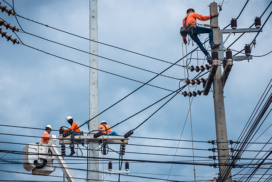
The 80/20 rule applied to workplace fatalities — why 13 hazard types generate 85% of all serious injuries and fatalities in high-risk operations.
Fatality rates haven’t moved in 20 years. Here’s the fix:
Recordable injuries have decreased, but workplace deaths remain unchanged. This is because the hazards that cause injuries are not always the same as those that lead to fatalities.
This free Intelex Insight Report introduces energy-based safety, a research-backed framework that applies the 80/20 rule to identify 13 high-energy hazards that cause 85% of serious injuries and fatalities.
Three effective tools to control these hazards
The guide also highlights three effective tools to control these hazards including:
- The Energy Wheel: Organizes hazards into 10 energy categories. Field experiments show that it improves hazard recognition by ~30% on average when used as a guidance tool during pre-job briefs.
- High Energy Control Assessments (HECA): HECA give companies a quantitative assessment of safety capacity in their job tasks by identifying high-energy hazards and measuring the percentage that have direct controls. These safeguards target the energy, mitigate or eliminate it, and work even if someone makes a mistake.
- Safety Classification and Learning (SCL) Model: SCL uses simple yes/no questions to classify incidents, near-misses, and observations into 7 categories. Improvement in safety event classification agreement went from 65% to 95% among safety professionals after implementing the SCL model.
Informed by practice. Shaped by experience.
Our team has over 30 years of EHSQ experience in high-risk operations around the world, and this guide is based on that knowledge, along with research from the Edison Electric Institute (EEI), and the Construction Safety Research Alliance (CSRA).